Key takeaways
- The short answer: for multi-market pharma organisations producing derivative content, a Content Authoring Solution is almost always the right move. The exceptions: very low content volume, a single-market portfolio, or an organisation not ready to own content in-house.
- Pharma content volume keeps rising — +7% globally, +29% in the US in a year — yet nearly 80% of approved content is rarely or never used in the field.
- A CAS restructures the content supply chain: from documents to reusable components, from agency queues to self-service, from late-stage review to compliant-by-design.
- The platform is only step one; the bigger gains come from who operates it. Self-service by local teams removes the queue entirely — and the case is broader than cost: speed, agility, reuse, MLR efficiency and AI readiness all improve together.
Pharma has a content paradox. Production volumes keep rising — up 7% globally and 29% in the US in a single year, according to Veeva benchmark data — yet nearly 80% of approved content is rarely or never used in the field. Meanwhile, the content that does matter routinely arrives weeks after the moment it was needed.
If you run content production, content excellence, or marketing operations at a large pharma company, you already feel this: more assets, same MLR capacity, growing agency invoices, and local teams waiting in a queue. The question is no longer whether to change the operating model, but how. A Content Authoring Solution (CAS) is one of the most direct levers available. This article lays out why, how it works, what it delivers — and how to judge whether it fits your goals.
Why: the economics of pharma content are broken
Three numbers tell the story.
| Signal | Industry benchmark | Source |
|---|
| Content volume growth |
+7% globally, +29% US (year over year) |
Veeva Content Benchmark |
| Approved content rarely or never used in the field |
~77–80% |
Veeva Pulse |
| Typical end-to-end cycle per asset (creation + pre-review + MLR) |
8+ weeks; review cycles of 50–60 days at large pharma are common |
Veeva, Vodori/Indegene surveys |
And the waste is not only in production. Veeva Pulse — the largest benchmark of HCP engagement, analyzing 600M+ interactions annually — shows that content-driven HCP engagement more than doubles treatment adoption, shortens time between meetings by up to 25%, and increases follow-up likelihood by up to 20%. Yet field teams use content in fewer than half of HCP meetings.
The real problem isn’t too little content. It’s the wrong content, too late, at too high a cost.
The traditional model — agency-led, asset-by-asset, rebuilt from scratch per market — cannot fix this. Every localisation is a new production job. Every review starts cold. Every change request goes back into a queue. Indegene estimates roughly 80% of pharma marketing spend goes into originating new concepts and only 20% into derivative content at scale — the exact inverse of where omnichannel demand actually sits.
How: what a Content Authoring Solution actually changes
A Content Authoring Solution (CAS) is a platform on which marketing teams create, adapt, and reuse compliant multi-channel content — email, CLM, web, banners, social — assembled from approved, modular components, with MLR guardrails built into the authoring process itself. It is not another point tool: it restructures the content supply chain around three shifts.
1. From documents to components. Claims, references, visuals, and modules are approved once and reused everywhere. New assets are assembled from governed building blocks, not rebuilt.
2. From agency queue to self-service. Local brand and digital teams create and adapt content themselves in no-code builders — for email, CLM/detail aids, web, banners, and social — within guardrails set by global and MLR.
3. From late-stage review to compliant-by-design. Templates carry approved claims, mandatory legal and regulatory elements, and auto-referencing. Pre-checks catch issues before MLR, so review validates rather than repairs. Companies that optimize MLR workflows this way have seen review cycle times drop by 57%.
The typical workflow looks like this:
Templates & components
→
Authoring
→
MLR pre-checks
→
Review & approval (Veeva Vault PromoMats)
→
Publish (Veeva CRM, SFMC, web)
Crucially, a CAS doesn’t replace your stack — it sits on top of it. Veeva Vault PromoMats remains the source of truth for review and approval; the CAS feeds it review-ready content and publishes approved output to your channels.
What: capabilities to look for
Not every authoring tool is a Content Authoring Solution. When evaluating, check for:
| Capability | Why it matters |
|---|
| No-code, multi-channel builders (email, CLM, web, banner, social) | One platform for every HCP channel, usable by marketers — not developers |
| Modular / component-based content | Create once, reuse globally; adapt locally without rebuilding |
| Governed templates with claims, references & mandatory elements | Compliance built in, not bolted on |
| MLR pre-checks and auto-referencing | Fewer review loops, faster approvals |
| Deep Veeva & SFMC integration | Fits your existing SOPs and document lifecycle |
| Structured content knowledge (machine-readable claims & modules) | The foundation for trustworthy AI content generation |
| AI grounded in your approved content — not the open web | Speed with traceability and a human in control |
| Usage & adoption support | Software only pays off if teams actually use it |
What “Veeva Vault PromoMats integration” actually means
Almost every authoring vendor claims Veeva integration — but the word covers very different depths of connection. When evaluating a CAS, ask which of these five levels it actually supports:
- File push — finished assets are exported into Vault as documents for review. The minimum bar; barely more than an upload.
- Metadata & lifecycle sync — document types, statuses, versions and fields stay synchronized both ways, so approval in Vault updates the asset everywhere it’s used.
- Round-trip review — content goes to review from the authoring tool, annotations and verdicts flow back, and revisions happen in place rather than via re-export.
- Claims & modular content sync — approved claims, references and content modules in Vault are available as governed building blocks during authoring, with links maintained.
- Channel packaging — approved content publishes from Vault to its destination automatically: Approved Email templates and fragments for Veeva CRM, CLM presentation packages, SFMC assets, web.
The deeper the level, the more the integration changes your operating model rather than just your file transfer. Shaman operates across levels two to five — including the claims-and-knowledge layer via Atlas — and holds a Certified Integration with Veeva Vault PromoMats in Veeva’s Product Partner Directory.
The benefits, quantified
The gains come in two steps. Step one: move from manual, asset-by-asset production to a Content Authoring Solution.
Step 1 — Manual model vs. CAS
| Dimension | Manual model (industry norm) | With a CAS |
|---|
| Speed | 4+ weeks content creation | Days per asset |
| MLR efficiency | 4+ weeks review, repeated loops | Cleaner submissions, fewer loops |
| Cost | Full agency production per asset, per market | Modular reuse cuts derivative production cost |
| Reuse | Every market rebuilds | Global-to-local adaptation from approved modules |
| Agility | Change requests queue for weeks | Faster turnaround on updates |
| AI readiness | Content locked in PDFs and slides | Structured knowledge that AI can safely use |
Step two matters just as much — and is often overlooked: who operates the CAS. When agencies run the platform, you get faster assembly but keep the hand-off, the briefing cycle, and the queue. When your own local teams run it, the queue disappears.
Step 2 — Agency-led CAS vs. self-service CAS
| Dimension | Agency-led CAS | Self-service CAS |
|---|
| Speed | Days — assembly is faster, but every change still enters a briefing queue | Hours — local teams create and update directly |
| MLR efficiency | Pre-checks help, but review comments loop back through the agency | Creators fix findings themselves, same day — 2–3 day reviews, up to 70% fewer loops |
| Cost | Platform efficiency, but agency fees remain on every asset and change | Up to 90% lower production cost on derivative content |
| Agility | Reaction speed limited by agency availability and scope | Market events answered same-day by the team that owns the market |
| Reuse | Modules reused when briefed to be | Local teams browse and reuse approved content directly |
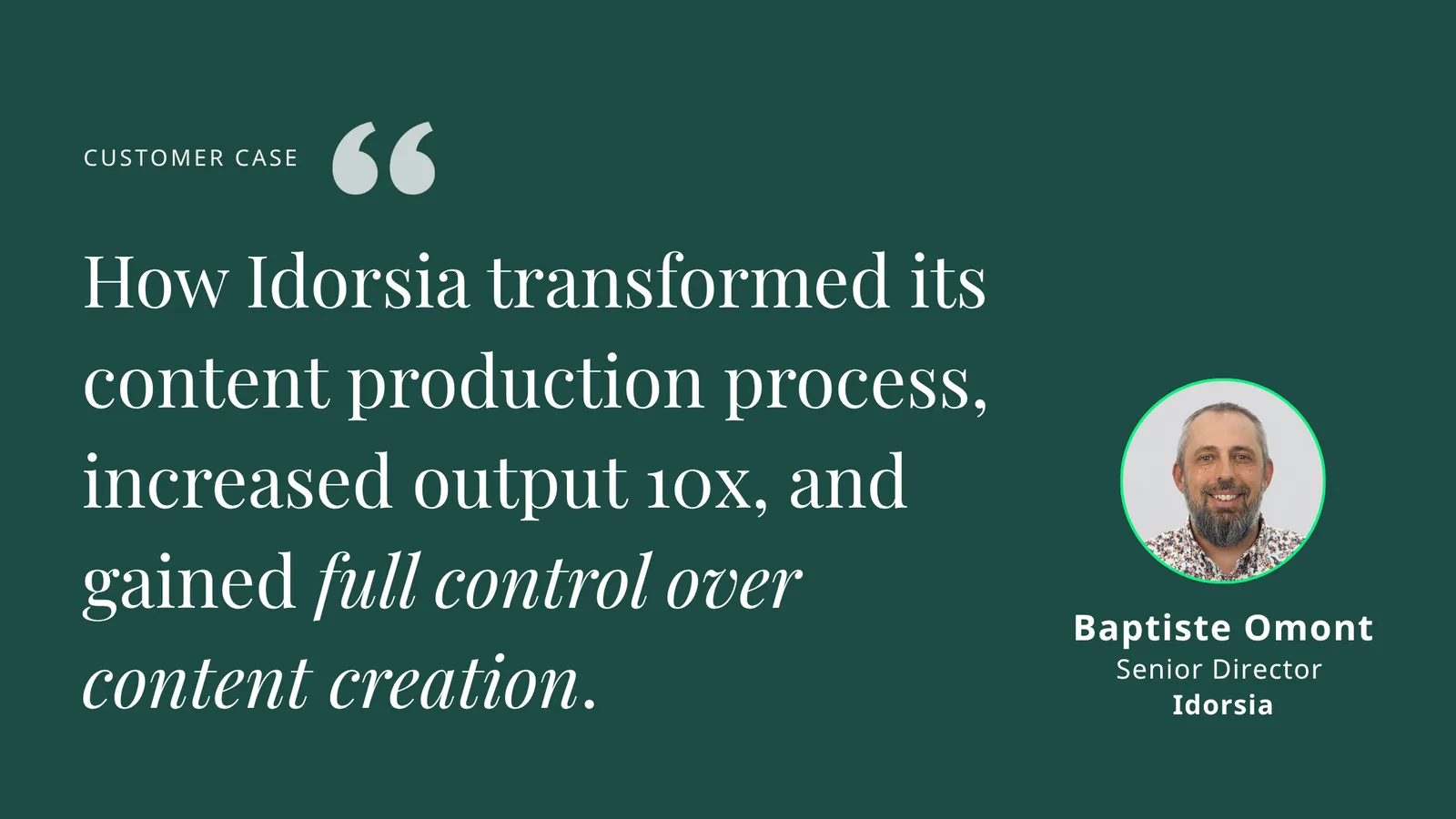
A concrete example: Idorsia brought self-service content production in-house and cut production time per asset from 3–5 weeks to 3–5 days — a roughly 10x productivity gain, with reduced dependency on external teams.
Fit: does it match your goals?
Map a CAS against the themes most content excellence teams are chartered on:
Speed & time-to-market. In pharma, the message that arrives eight weeks late is a message wasted. Veeva data shows pre-review processes alone can add 5–150 days per asset. A CAS attacks both ends: faster assembly and faster review.
Agility. Local teams are closest to the market — new competitor data, a congress, a label update. An agency-led CAS speeds production, but only self-service removes the queue: the people who own the market respond in hours, not weeks.
Cost. McKinsey estimates GenAI alone can cut content creation costs 30–50%. Combine that with modular reuse and in-house self-service, and derivative content costs collapse — freeing agency budget for what agencies do best: net-new creative and launch campaigns. To model the numbers for your own volumes and markets, use the content production calculator.
Reuse, global-to-local, modules. Modular content is the mechanism that turns one approval into many assets. Global creates the components; local assembles, translates, and adapts — with brand and compliance guardrails intact.
MLR efficiencies. Compliant-by-design authoring means MLR reviews cleaner submissions with pre-validated claims and references. Fewer loops, shorter cycles, and reviewer capacity that scales with volume instead of breaking under it.
AI content production. AI is only as trustworthy as the knowledge it draws on. A CAS that structures your approved content into machine-readable knowledge gives AI a compliant foundation — so generation is traceable, grounded, and review-ready rather than a new compliance risk.
When a CAS is not the right move (yet): if your content volume is very low, your portfolio is single-market, or your organisation isn’t ready to shift day-to-day ownership to internal teams, fix the operating model question first. Technology amplifies an operating model — it doesn’t substitute for one.
Where Shaman fits
Shaman was built for exactly this shift — and with one deliberate difference in philosophy:
The team that owns the market owns the content.
Most content authoring systems are built to be run by agencies; that makes the hand-off faster. Shaman is built to be run by your local brand and digital teams — so the hand-off, the queue, and the noise disappear. Agencies keep doing what they do best (net-new creative, brand systems, launches), and they can do it in Shaman too. What changes is who owns the day-to-day.
One platform, three capabilities:
| Capability | What it does |
|---|
| Shaman Authoring | Self-service, no-code builders for every HCP channel — email, CLM/detail aid, web, banners, social — optimised for global-to-local reuse |
| Shaman MLR | Compliant by design: governed templates, claims and references, auto-referencing, and MLR pre-checks that keep every asset review-ready |
| Shaman Atlas | A Medical, Legal & Regulatory knowledge engine that turns approved content into structured, machine-readable knowledge — for people and AI |
AI is baked in throughout (search, translation, text generation, tagging, proofreading), and Aurora adds an agentic layer on top: specialised agents that create and edit with you, drawing only on your approved, MLR-cleared knowledge and brand strategy — never the open web. Every output traceable, human in control.
And it fits the stack you already run: deep integration with Veeva Vault PromoMats and Veeva CRM (Shaman is a Veeva Silver Product, AI, and Content Partner), Salesforce Marketing Cloud and Life Sciences Cloud, SOC 2 Type II certified.
The results customers report:
- Content production from 4+ weeks to about an hour, at up to 90% lower cost
- MLR review from 4+ weeks to 2–3 days, with 70% fewer review loops
- Used by 5 of the top 20 pharma companies, with 10+ years in pharma content
And the numbers that matter most for a self-service model — the ones few vendors can show, because most platforms are still operated by agencies or central studios:
- Over 80% active users among licensed local team members
- More than 65% of all content produced self-service, by local brand and digital teams themselves
Self-service is easy to claim and hard to prove. Adoption rate and self-service content rate are the proof — ask any vendor for theirs.
Sources: Veeva Pulse Field Trends Reports & Veeva Content Benchmark data; Veeva MLR optimization research; Vodori & Indegene MLR cycle surveys (2024); Indegene content operations research; McKinsey, “Generative AI in the pharmaceutical industry” (2024); Shaman customer data and the Idorsia case study.
Frequently asked questions
What is a Content Authoring Solution (CAS)?
A Content Authoring Solution is a platform on which marketing teams create, adapt, and reuse compliant multi-channel pharma content — email, CLM/detail aids, web, banners, social — assembled from approved, modular components with MLR guardrails built into authoring. It sits on top of your existing stack: Veeva Vault PromoMats remains the system of record for review and approval.
What is the difference between an agency-led and a self-service CAS?
Who operates it. When agencies run the platform, assembly is faster but every change still enters a briefing queue. When your own local brand and digital teams run it, the queue disappears: creators respond to review findings the same day, adapt content in hours, and reuse approved modules directly. Ask vendors for their adoption rate and self-service content rate — that is where the difference shows.
How much time and cost does a CAS save?
Idorsia cut production time per asset from 3–5 weeks to 3–5 days by bringing self-service production in-house. Shaman customers report content production going from 4+ weeks to about an hour at up to 90% lower cost on derivative content, and MLR review from 4+ weeks to 2–3 days with 70% fewer review loops. Your numbers depend on volumes and markets — model them with the content production calculator.
Which content authoring platforms integrate with Veeva Vault PromoMats?
Authoring tools connect to PromoMats at very different depths — from simple file push to claims-level knowledge sync (see the five levels above). Veeva’s own tooling covers specific assembly steps; dedicated pharma authoring platforms go further. Shaman is a Veeva Silver Product, AI and Content Partner with a Certified Integration for Veeva Vault PromoMats, spanning metadata and lifecycle sync, round-trip review, claims and modular content via Atlas, and packaging for Approved Email, CLM and web. Whichever platform you evaluate, ask for the certification and a live demo of the round trip.
When is a CAS not the right choice?
When content volume is very low, the portfolio is single-market, or the organisation isn’t ready to shift day-to-day content ownership to internal teams. In those cases, fix the operating model first — technology amplifies an operating model, it doesn’t substitute for one.

About the author
Maurice van Leeuwen · CEO & Chief Product Officer, Shaman
Maurice has spent the past decade making content authoring solutions a reality in pharma — helping large life sciences organisations embed CAS platforms and workflows into their daily content operations, and partnering with Veeva, agencies of record and content-production consultancies to advance the field. Connect on LinkedIn.