
Key takeaways
- MLR precheck tools check content against approved claims, references, label language and mandatory elements before it enters formal review.
- There are four categories, defined by where the check happens: in the MLR system of record, standalone AI engines, authoring platforms with compliance built in, and service-led approaches.
- The later the check, the more rework: detection finds issues after content is built; authoring-side guardrails prevent them from existing.
- Whatever the category, demand traceable findings, human-in-the-loop workflow and deep integration with the system of record.
MLR review is a bottleneck everyone experiences differently. Marketers see campaigns stuck in review while deadlines pass. Reviewers see queues filled with drafts carrying the same avoidable issues — a reference that doesn’t quite support the claim, a missing safety statement, a superlative that medical will never accept. Content production managers see the compound effect: rework, resubmissions, and localization backlogs that multiply with every market.
Most promotional assets go through two to three MLR cycles before approval — new campaigns and comparative claims often more — and a single asset can take 20–50 days to clear review at a mid-to-large pharma company. Much of that time goes to issues that never needed to reach a reviewer.
This is the problem MLR precheck tools set out to solve. Instead of waiting for human reviewers to find these issues, software checks content against approved claims, references, brand requirements, label language, and local rules — before it enters formal review. The goal is not to replace reviewers, but to make sure that when content reaches them, it’s actually ready.
With rapid developments in the AI space, the market for these tools has grown fast. Analysts value the broader MLR software space at roughly $17 billion in 2025, with projections toward $42 billion by 2035. And in June 2026, Veeva — the dominant platform in pharma content management — made a big move by acquiring Copli and launching Veeva Falcon MLR. Here is an overview of the landscape, and where each type of solution fits.
What precheck actually checks
Despite different architectures and marketing, credible precheck tools converge on the same categories:
- Claim detection and substantiation — finding explicit and implied claims in copy, headlines, and visuals, and matching them to approved claims, references, or label sections
- On-label / off-label risk — checking indication, population, dosage, and comparators
- Fair balance and safety — verifying that risk information, ISI, and warnings are present and prominent
- Reference integrity — confirming references exist, are current, and support the exact claim
- Mandatory legal and regulatory elements — PI links, legal footers, local disclaimers, unsubscribe links
- Similarity to approved content — identifying what is net-new versus already approved, so reviewers focus scrutiny where it matters
The best tools don’t just return a compliant/non-compliant verdict. They return structured findings with severity, source, explanation, and a suggested fix — traceable to a specific label section, claim, or prior approval. In MLR, “the AI thinks this is risky” is not enough.
The landscape: four ways to precheck
The most useful way to compare vendors is not by feature list, but by where in the content lifecycle the check happens.
1. Inside the MLR system of record
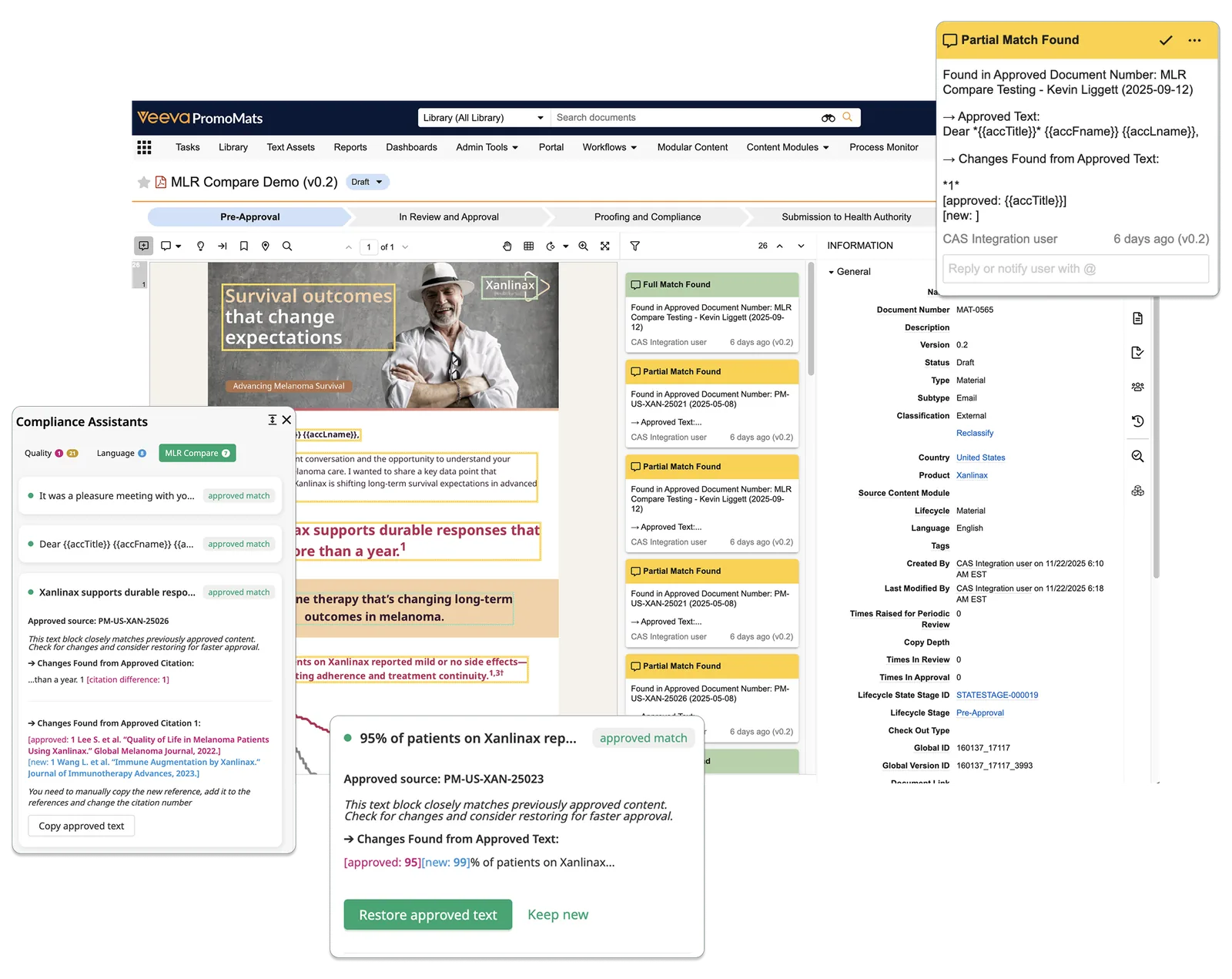
Veeva Vault PromoMats is the gravitational center of the market — the de facto standard for managing regulated content and MLR workflow at large pharma. Veeva has been adding AI steadily: an MLR Bot and Quick Check Agent that scan content against editorial, brand, channel, and compliance guidelines before formal review, with data never leaving the Vault environment.
In June 2026, Veeva accelerated dramatically by acquiring Copli, a Copenhagen-based pioneer in agentic MLR, and launching it as Veeva Falcon MLR. Falcon MLR uses intelligent agents to review promotional and medical materials against approved labels and local regulations, and Veeva states it has the potential to eliminate 70% or more of manual MLR labor within five years. It works seamlessly with PromoMats and targets marketing teams, MLR groups, and agencies alike.
Vodori’s Pepper Flow takes a related position as a dedicated MLR review platform, with a stated AI roadmap emphasizing explainable, deterministic, GxP-validated checks — a deliberate contrast to pure generative AI.
StrengthNative MLR context, adoption, and audit trail.
LimitationThe check happens late. By the time content is in the system of record, it has already been built — errors are found, not prevented.
2. Standalone AI precheck engines
A wave of AI-native specialists positions precheck as the core product, sitting between content creation and formal MLR submission. SecureCHEK AI combines analytical AI (structured rules, claims libraries) with generative AI for contextual reasoning, and reports a 70% faster QC process. Revisto, backed by Eli Lilly among others, analyzes full documents in a single cycle and reports review-cycle reductions of up to 90%. EVERSANA ORCHESTRATE MLR, built on AWS Bedrock with deep PromoMats integration, automates claims identification, extraction, and cross-referencing, reporting a 50% reduction in review time. Lyriko (Hyntelo) runs configurable six-dimension checks natively inside PromoMats. Others — Red Marker, AutoMLR, MarketBeam for social content — cover specific niches or regulatory geographies.
StrengthAI depth and speed; often the fastest way to add intelligence on top of an existing stack.
LimitationThese tools add another layer. Findings must flow back into the official workflow, and content still has to be fixed after it was built.
3. Authoring platforms with compliance built in
The third category moves the check to the earliest possible point: while content is being created. Platforms like Shaman and Viseven embed compliance guardrails directly into the authoring environment, so issues are caught while the content is still editable — before they ever become an MLR comment.
The logic is simple: the cheapest compliance issue is the one that never happens. If authors work from approved claims, linked references, and validated templates from the start, there is structurally less for MLR to find.
StrengthPrevents issues upstream rather than detecting them downstream; shortens the entire cycle, not just the review step.
LimitationThe upstream checks must be trusted by MLR teams and synchronized with the system of record — which makes deep Veeva integration essential.
4. Service-led approaches
Finally, firms like Indegene, IQVIA, and BASE life science offer AI-assisted MLR as part of broader consulting and managed-service engagements. These suit large organizations that need operating-model redesign, custom governance, and validation support.
StrengthCustom governance, validation support, and operating-model redesign at enterprise scale.
LimitationLess productized and harder to compare, with a higher dependency on the vendor’s services arm.
The four categories at a glance

Maurice has spent the past decade making content authoring solutions a reality in pharma — helping large life sciences organisations embed CAS platforms and workflows into their daily content operations, and partnering with Veeva, agencies of record and content-production consultancies to advance the field. Connect on LinkedIn.