Modular content is a structure problem, not a storage problem.
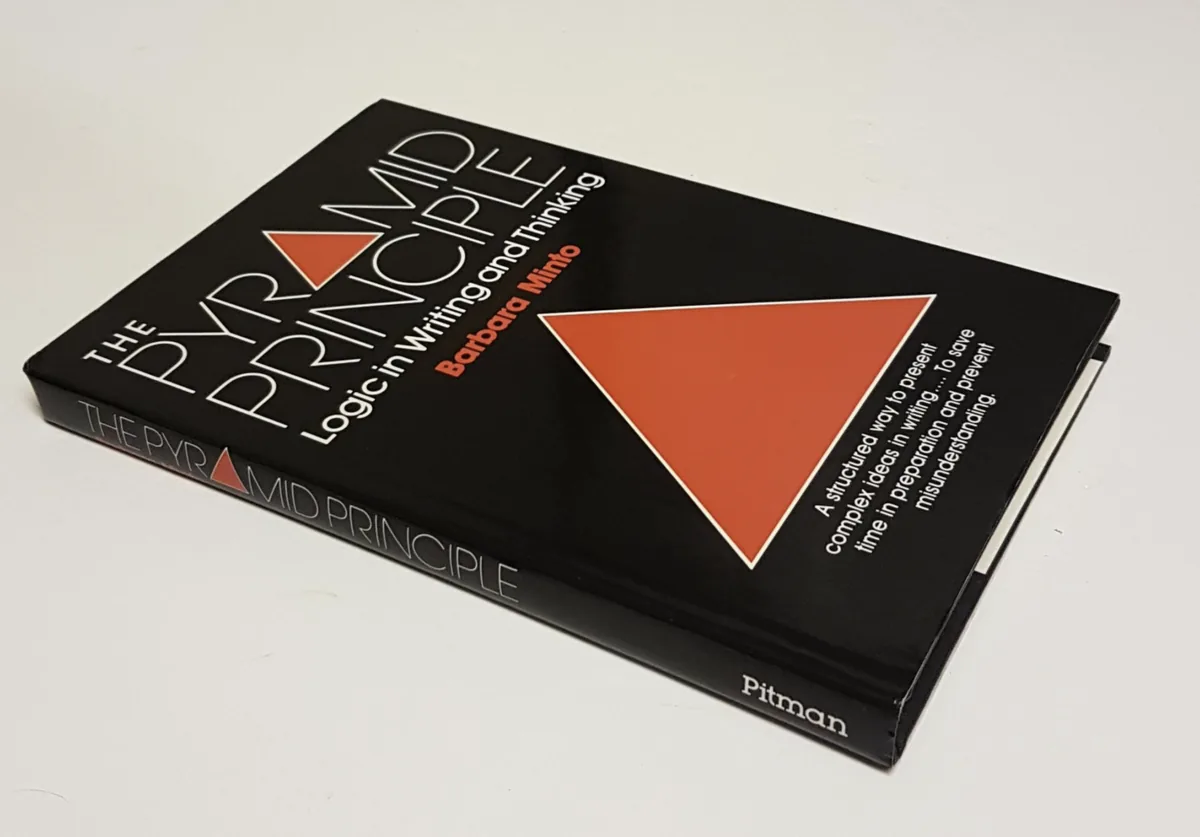
What a forty-year-old McKinsey book — Barbara Minto’s The Pyramid Principle — teaches pharma about why module libraries stall, and how to build one that actually delivers reuse.
Most modular content programs stall because they treat modular content as a storage problem — maintaining items in a library — when it is actually a structure problem: how the arguments of your stories are organised.
Minto’s first rule: the claim header is the governing thought and everything beneath it exists to support it. The unit of storage and reuse is the claim in context — the content card — not the free-floating atomic claim.
MECE gives the sizing logic nobody applies: map indications × message themes and cover every combination with exactly one card. More is overlap (variant sprawl); less is a gap (improvisation risk).
SCQ reveals that cards have narrative roles — context, unmet needs and claim cards — and the role determines reuse scope, review depth and how freely a card may vary.
Put the three together and the conclusion is that the core should be small: a few deeply substantiated claims, assembled into many assets with a real narrative arc.
Every pharma company is investing in modular content. Libraries are being built, taxonomies defined, Veeva integrations configured, reuse dashboards launched. The promise is compelling: create once, approve once, reuse everywhere.
And yet most programs stall. The library fills with near-duplicate modules. Local teams can’t find what they need, so they create new content anyway. MLR reviews the same claim theme five times, because it comes in five different wordings. Reuse rates are embarrassing, and the question lands on someone’s desk: why isn’t the modular content investment paying off?
Why does modular content underdeliver so consistently, across so many companies?
A key reason, I propose: most teams treat modular content as a storage problem — maintaining items in a library — when it is actually a structure problem. What do I mean by that? Think about modular content as storytelling. As a collection of arguments. Call it modular storytelling: the next step beyond modular content. That gives you a different perspective on the key challenge, which becomes: how to structure the arguments of your stories. And the best guide to those rules isn’t a pharma playbook at all.
I propose reading Barbara Minto’s The Pyramid Principle instead — written for McKinsey consultants, over forty years ago. Minto’s three core ideas — answer-first hierarchy, MECE grouping, and the SCQ narrative — map almost perfectly onto what a working modular content system needs.
Let me take them one at a time.
1. The claim header leads; everything else is support
Minto’s first rule: lead with the governing thought. A story is built from hierarchy. At the top sits the governing thought, and every idea below it exists for one reason only: to support the idea above it. So an eDetailer slide isn’t a collection of points — it’s a hierarchy with a single conclusion at the top.
Now look at a well-built content module in pharma. At the top sits what we like to call the claim header: the core message, the governing thought, the H1 text. Beneath it: supporting evidence, supporting visuals, supporting text, footnotes, and references anchored to the source study. Supporting evidence can carry trailing headers or captions. None of these elements has an independent existence — they all work together to substantiate the claim header above them.
That is a pyramid. The claim is the governing thought; substantiation is the vertical relationship.
This leads to a conclusion that cuts against a common mental model of modular content — the atomic claims library: store claims individually, let teams combine them freely, and scale through recombination. The pyramid principle says this is backwards. A claim doesn’t carry its meaning alone; it carries it through its position in an argument — the evidence beneath it, the message above it, the claims beside it. Store claims as free-floating atoms and you don’t get reuse, you get recombination risk: technically approved statements assembled into implications nobody approved.
So claims shouldn’t be stored separately at all. The unit of storage — and of reuse — is the claim in context: bundled with its substantiation and anchored in a deliberately crafted message structure. We call that bundle the content card. Reuse means deploying the card again, not remixing its parts.
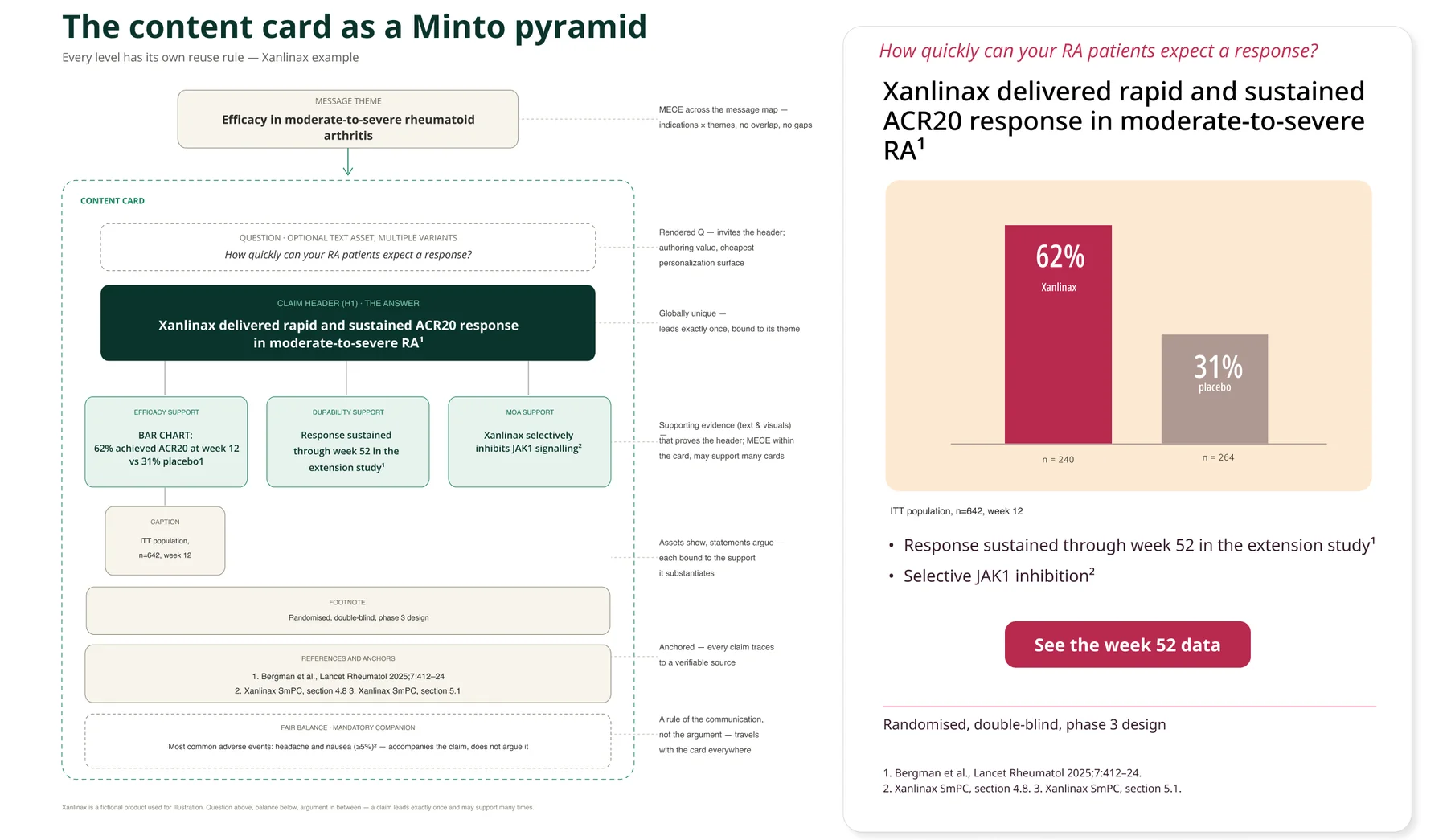
For MLR, this changes the unit of approval. Reviewers shouldn’t be looking at individual fragments; they should be looking at the pyramid itself: a claim header packaged with the evidence that carries it, within the messaging it was designed for. Approve that as one object and two things follow: review gets faster, and downstream reuse is safe by construction. Approve loose atoms, and every new combination reopens the compliance discussion from scratch — because in truth, every new combination is a new message. The figure below shows what that pyramid looks like as a content card — the structure, and the same card rendered as a finished asset.
The content card as a Minto pyramid — the structure on the left, the same card rendered as a finished asset on the right. Xanlinax is a fictional product used for illustration.
2. MECE — the sizing logic nobody applies
Minto’s second rule is the one every consultant remembers: groupings must be mutually exclusive, collectively exhaustive. No overlap between the parts, no gaps in the whole.
Module libraries fail in exactly these two ways.
Overlap is the visible failure. Five near-identical claims saying roughly the same thing in slightly different words. Variant sprawl. The daily question from local teams: which one do I use? And the expensive consequence: MLR reviewing the same idea multiple times, because nobody established that these variants belong to one canonical claim.
Gaps are the dangerous failure, and they occur at two levels. At the library level: parts of the story that no approved card covers, which leads to improvisation and compliance risk. At the module level: the card exists but is incomplete — an aspect of the header left unproven, a support without evidence, a missing anchor. This is the sneakier gap, because the card looks legitimate. Both violate collective exhaustiveness, and both can be avoided when the MECE principle is applied rigorously.
MECE gives you the sizing logic for a claim library that almost nobody applies deliberately: indications × message themes. That map is your library’s natural shape. Each combination gets exactly one card — one claim header, with controlled variants inside it. Not more — that’s overlap. Not less — that’s a gap.
One precision: not every claim is indication-bound. A mechanism-of-action card is true for every indication on the label. Efficacy can never do this; the data is per-indication by nature. The rule in full: every combination is covered by exactly one card, but a card may cover several combinations when the claim is genuinely indication-independent.
Minto adds a second discipline here: every grouping must be summarisable by a single parent statement. If you can’t summarise the group in one sentence, the grouping is wrong. Applied to modular content, this becomes the summary test: if a set of variants cannot be summarised by one parent claim, they are not variants — they are different claims, and they belong in different cards. That’s a simple forty-year-old deduplication rule, and it still holds.
3. SCQ — content cards have narrative roles
Module business rules define what may be assembled together. But they say nothing about how to deliver the story. Minto’s third idea: before delivering your message, earn attention with Situation > Complication > Question. It builds context for the reader and naturally raises a question — so that your core message arrives as the powerful answer the reader is already looking for.
Applied to a card library, SCQ reveals something the atomic model can’t see: cards have narrative roles, and the role determines how a card is used — its reuse scope, its review depth, and how freely it may vary. We suggest a typology of content cards:
Card type
Minto role
What it carries
Reuse & review
Context cards
Situation
Disease-level claims: epidemiology, disease burden, pathophysiology. No product mention.
Broad reuse across themes and even brands; lighter review
Unmet Needs cards
Complication
The tension of the story: the unmet need and the limits of current practice
Reusable, but handled with care — implied comparative claims live here
Claim cards
Answer
The core messages and product claims
Bound to their place on the message map; heaviest review; never varied
Note that context and unmet-needs content are claims too — they need references and approval like everything else, which is exactly why they should be cards and not free text. And the typology does more than organise the library: it helps authors think about constructing an effective story.
The Q — the question — needs no card of its own. We suggest the question lives inside the claim card, as a separate text asset: optional, with multiple variants allowed. It adds little for MLR, but it helps a great deal in shaping the message during authoring. Put the roles in sequence and you get SCQA — the medical story arc every asset should follow:
SCQA — the medical story arc: Situation, Complication and Question earn attention; the claim card delivers the answer, with its support beneath it. Xanlinax is a fictional product used for illustration.
Small core, big leverage
Put the three ideas together and the pyramid explains something the modular content industry keeps rediscovering the hard way: the core should be small.
A small set of theme-based claims, each with one header and a deep, well-anchored support structure. A MECE message map that tells you exactly how many claims you need — and how many you don’t. Assembly logic that turns those few claims into many assets, each with a real narrative arc. That is modular storytelling — and it’s not bad for a forty-year-old book.
Minto tests to audit your library
The context test — is every claim stored with its substantiation and its message structure? Free-floating claims are recombination risk, not reuse.
The summary test — can every group of variants be summarised by one parent claim? If not, split them.
The map test — plot your claims on indications × themes. Where’s the overlap? Where are the gaps?
Minto knew that ideas only work when they’re organised as an argument. So does content.
What does it mean that modular content is a structure problem, not a storage problem?
Most programs focus on storing items in a library — taxonomies, metadata, integrations. But modular content is storytelling: a collection of arguments. The real challenge is how the arguments of your stories are structured — how claims relate to their evidence, to the messages above them, and to the claims beside them. Get the structure right and storage becomes simple; get it wrong and no library fixes it.
What is modular storytelling?
Modular storytelling is the next step beyond modular content: instead of storing reusable blocks, you structure content as arguments. Claims lead as headers, evidence supports them, and cards carry narrative roles — context, unmet needs and claim — so assembled assets read as stories rather than stacked modules. Modular content stores bricks; modular storytelling builds arguments.
What is the Pyramid Principle and how does it apply to modular content?
The Pyramid Principle is Barbara Minto’s method for structuring arguments, written for McKinsey consultants over forty years ago. Its three core ideas — answer-first hierarchy, MECE grouping, and the Situation-Complication-Question narrative — map almost perfectly onto what a working modular content system needs: claim-led content cards, a message map sized by indications × themes, and cards with explicit narrative roles.
Why shouldn’t claims be stored as individual atoms?
A claim doesn’t carry its meaning alone — it carries it through its position in an argument: the evidence beneath it, the message above it, the claims beside it. Store claims as free-floating atoms and you get recombination risk: technically approved statements assembled into implications nobody approved. The unit of storage and reuse should be the claim in context — the content card — bundled with its substantiation.
How do you size a modular content library?
Map indications × message themes. Each combination gets exactly one content card — one claim header, with controlled variants inside it. More than one card per cell is overlap (variant sprawl, repeated MLR review); an empty cell is a gap (improvisation risk). A card may cover several combinations only when the claim is genuinely indication-independent, such as mechanism of action.
Maurice has spent the past decade making content authoring solutions a reality in pharma — helping large life sciences organisations embed CAS platforms and workflows into their daily content operations, and partnering with Veeva, agencies of record and content-production consultancies to advance the field. Connect on LinkedIn.

 Maurice van Leeuwen