Key takeaways
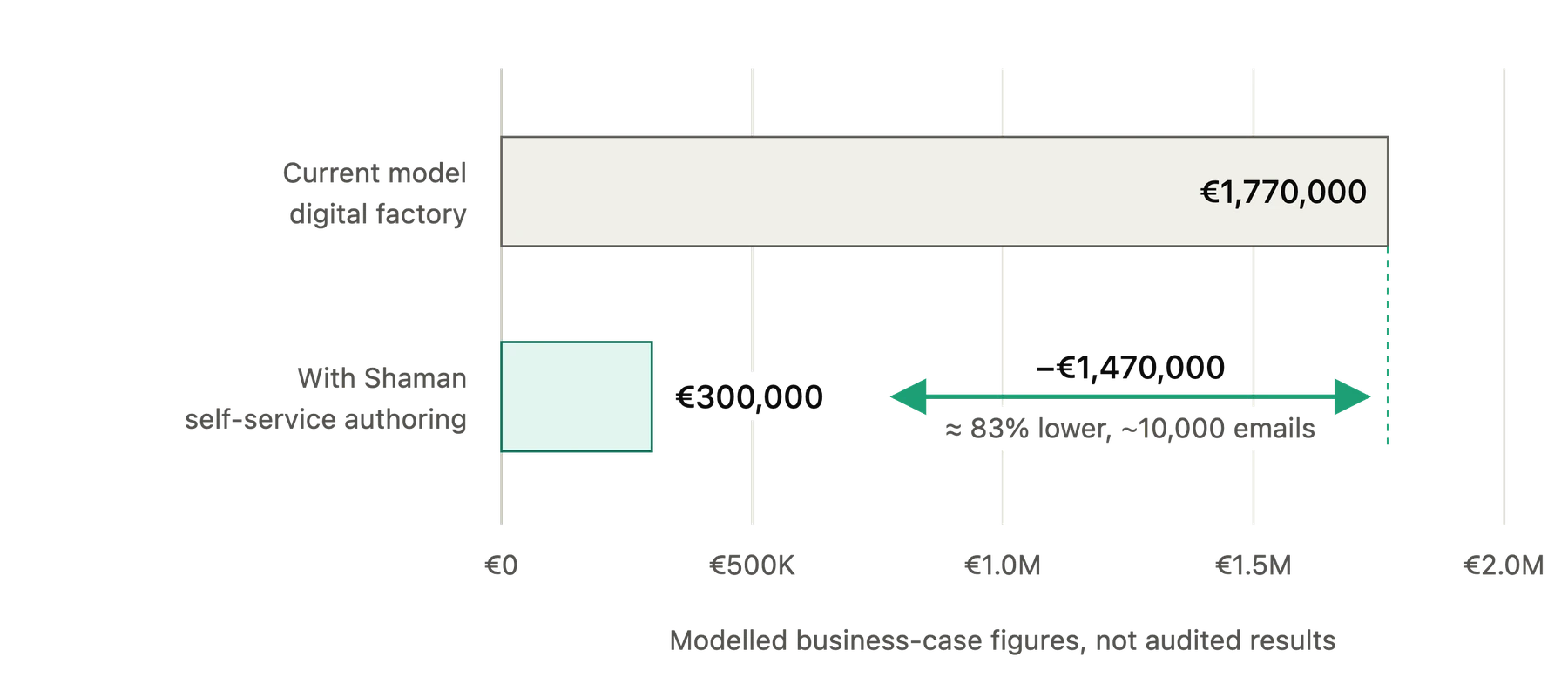
- A real-world business case put a number on pharma content production costs. A global pharmaceutical organisation calculated its digital factory production cost for roughly 10,000 marketing emails at approximately €1.77 million, against a modelled €300,000 under self-service content authoring, a potential difference of €1.47 million.
- The saving is structural, not incremental. It comes from removing steps, handoffs and iterations from the production chain, not from running the same process more cheaply.
- A digital factory is not the problem in itself. Centralising production in a global digital factory already replaced many local production agencies. A content authoring system (CAS) is the next step of automation on top of that model.
- Local knowledge makes local content relevant. Self-service puts creation in the hands of local content strategists, the people who know their market, their HCPs and their situation best.
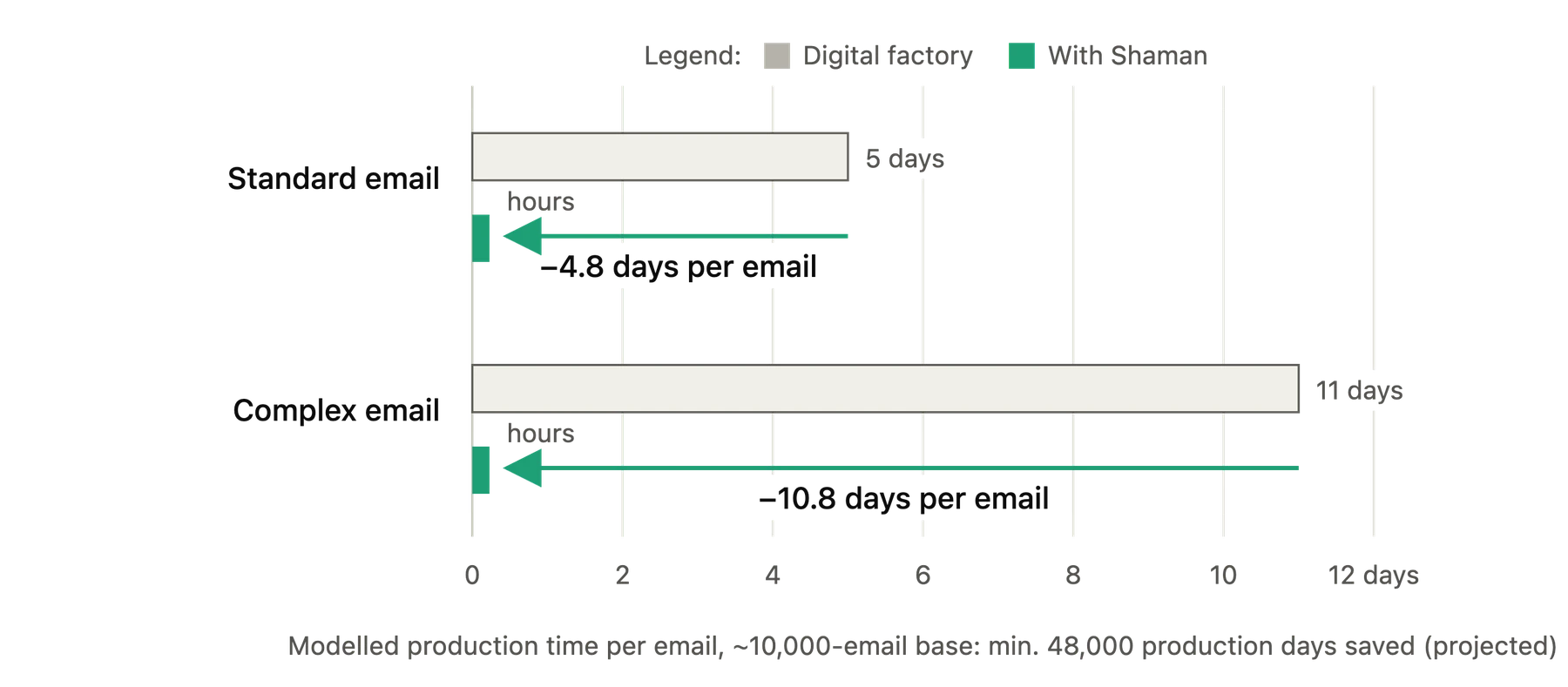
- Time to market can fall from days to hours. The same business case modelled production time dropping from five days (standard email) and eleven days (complex email) to a matter of hours under self-service authoring.
- None of it works without adoption. Templates, reusable content and workflow integration only produce this result if content teams actually use the platform to build real campaigns.
- Email was the starting point, not the destination. The organisation’s own plans extend the same reuse economics to other channels and to AI-assisted MLR review.
This business case is based on an enterprise Shaman implementation. The organisation has been anonymised for confidentiality: no company, brand, therapeutic area, market or campaign detail is disclosed, and every figure below is labelled as realised, modelled, projected or qualitative.
The business question: what does your content operating model actually cost?
Pharma organisations have spent the past five years investing in content technology: modular content libraries, omnichannel platforms, AI-assisted MLR review, digital asset management, almost always justified by an appeal to speed, compliance or customer experience. One question tends to get asked less often, and answered with even less precision: what does the current content production operating model actually cost, per asset, per market, per year?
Most Content Excellence and Content Operations leaders can describe their technology stack in detail. Far fewer can put a defensible number against the cost and cycle time of producing a single approved email, banner or detail aid, because that cost is scattered across agency retainers, internal headcount, translation vendors, MLR review cycles and the opportunity cost of campaigns that miss their moment.
A real-world business case: sizing the opportunity
A global pharmaceutical organisation built a business case around a defined, high-volume content category: marketing and approved emails, at a base volume of roughly 10,000 emails. Email was chosen deliberately. It is high-volume, repeatable, produced across many markets from shared global source material, and subject to the same MLR requirements as any other promotional asset: a clean, representative unit for comparing two production models rather than an edge case.
The comparison was simple in structure. What does it cost, in money and in time, to produce this volume of compliant, localised content under a digital factory model, in which a centralised global digital agency builds each asset from a local brief, versus a self-service content authoring model, in which trained in-market and global content teams build approved, on-brand content themselves inside a governed authoring platform?
What is self-service content authoring in pharma?
Self-service content authoring is a model in which marketing, medical and content teams create compliant, on-brand assets directly, using governed templates with locked local legal and regulatory statements, pre-approved content blocks and built-in MLR guardrails, rather than briefing every asset to an external agency or production team. The platform enforces brand and regulatory rules by design, so authors work inside approved constraints instead of being reviewed into them after the fact.
This is different from handing marketers a blank design tool. The model pharma organisations are adopting typically combines a library of pre-approved, reusable content and claims, templated structures that encode brand and regulatory rules into the build itself, and a workflow that identifies reused and new claims. (For the distinction between content authoring as process automation and self-service as the next level on top of it, see our guide to pharma content authoring platforms.)
The digital factory: a big step, but not the last one
The baseline in this business case was not a legacy model. The organisation had already moved from many production agencies, one or more per market, to a centralised global digital factory: one specialised production partner building assets for all markets from local briefs. That consolidation is a significant improvement in itself. It standardises quality, pools expertise and removes duplicated agency overhead across countries.
What it does not remove is the brief-build-review chain. Even in a digital factory, production cost is spread across agency fees, internal briefing and coordination time and feedback cycles, translation and localisation, revisions, and the compliance review each version triggers, and those costs recur for every market variant of every asset. The process around it still contains a sequence of handoffs. A content authoring solution (CAS) is the next step of automation: it takes the standardised, governed output of the factory model and lets local teams produce it themselves.
A single approved email is rarely produced once. A global template is typically adapted, translated, re-reviewed and re-approved for each local market, and every step carries both a direct cost (agency or vendor time) and an indirect one (the calendar time a brand or medical team spends waiting). Complexity compounds this: a standard email is materially cheaper and faster to produce than a complex one involving more assets, claims or markets, but both still pass through essentially the same production and review chain.
How much can self-service content authoring reduce production costs?
In this business case, the organisation calculated a digital factory production cost of approximately €1.77 million for its base of roughly 10,000 marketing and approved emails, against a modelled cost of approximately €300,000 for the same volume under a self-service authoring approach: a potential production cost difference of approximately €1.47 million. These are business-case figures from the organisation’s own model, not independently audited or externally benchmarked results.
| Email type | Digital factory production | Self-service authoring (modelled) |
|---|
| Standard email | 5 days | 30–60 minutes (≈4.8 days less) |
| Complex email | 11 days | 2 hours (≈10.8 days less) |
| Outlook, full ≈10,000-email base | — | Minimum 48,000 production days saved (projected) |
Table 2. Modelled production time, digital factory vs. self-service.
Applied across the full email base, the organisation’s business case set out an outlook, explicitly framed as a projection rather than a measured outcome, of a minimum of 48,000 production days saved, using the more conservative of the two per-email time savings across the full volume.
Operationally, that shift matters more than the headline number suggests. Local markets can react to a competitor move or a seasonal moment without queuing behind a shared production calendar. Content that would previously have missed its window has a realistic chance of shipping on time. Global teams spend less time on production logistics and more on strategy and measurement. And agency dependency shifts from being a bottleneck for high-volume, templatable content to a resource reserved for genuinely novel creative work.
What drives the cost and time difference?
The gap is not explained by a content authoring system (CAS) being a cheaper way to do the same work. It is explained by how much of the digital factory production chain a CAS removes, automates or collapses into a single step.
Fewer steps, fewer handoffs
In the digital factory model, a single email passes through briefing, agency build, selection of content and assets in PromoMats, content QC, proofreading, reference linking and review, with the work handed back and forth between a local content strategist and a global digital agency specialist. A CAS removes or automates most of these steps and cuts the number of handoffs between the two. Every handoff removed is time that no longer sits in someone’s queue.
Brief and build in one step
The split between briefing and creation is itself a source of cost. A strategist writes a brief, an agency specialist interprets it, the result comes back days later, and the gap between intent and output is closed through iteration. In a CAS, the content strategist strategises and creates at the same time: they see the result immediately and can optimise on the spot, without a round trip. It is a modern way of working with a short feedback loop, and it recognises that separating brief from creation introduces unnecessary iterations by design.
Less noise between strategist and agency
Beyond the formal iterations, a great deal of production time in the digital factory model is spent on the noise between the content strategist and the agency specialist: clarifying questions, misread briefs, missing assets, wrong versions, status chasing. None of it shows up as a line item, and all of it adds calendar days and billable hours.
Compliance and brand rules built into the template
A CAS always serves the latest design template and enforces the brand design system. It automatically resizes images, adds alt text, checks for mandatory legal and regulatory statements and generates the reference list. Work that previously required a separate QC and proofreading pass, and often a further review cycle, is handled structurally at the point of creation.
HTML output included
A CAS produces the final email HTML as part of creation. There is no separate HTML build step, no coding vendor, and no additional QC of the coded result against the approved design.
A fully integrated, traceable workflow
The authoring workflow can be fully integrated with PromoMats and the MLR process, removing manual steps and the untraceable, unlinked content versions that accumulate when files move between inboxes, shared drives and agency systems. Content has one source, one version and one audit trail.
Inefficiency costs money even when labour is cheap
An inefficient process with many handoffs and manual steps does not only take longer to produce content; every additional step, iteration and correction carries a cost, and those costs compound across roughly 10,000 emails. Even with low hourly labour rates, the volume of touches in the digital factory chain is what makes it expensive. Removing the touches is what makes the saving structural rather than incremental.
Lesson learned: the saving comes from changing how many times a piece of content has to be touched, handed off and reviewed, not from negotiating a better day rate on the same process.
Why self-service for local content strategists?
Cost and speed are only half of the case. Shaman’s view is that content should be created by the people closest to the customer: local content strategists who know their market, their HCPs and the situation on the ground. A global digital factory can build a technically flawless email, but it cannot know that a local guideline just changed, that a competitor launched last week, or how a specialist in one country phrases the question a sales rep gets asked most. The local strategist knows, and in a self-service model they can act on it the same day, inside governed templates and pre-approved content that keep the result compliant and on-brand.
The result is content that is not just cheaper and faster, but more relevant: locally coloured messaging, built from global core content, by someone who understands what will resonate. That is why the business case credits adoption by local teams as a mechanism, and not just an outcome.
What made the operating model more efficient?
The business case attributes the change to five connected mechanisms, not to authoring software alone. This distinction matters: it is the difference between “doing agency work internally” and genuinely changing the operating model.
| Mechanism | What it changes |
|---|
| Templatisation | Brand and regulatory rules become structural constraints on the platform, not checklist items applied during review |
| Global-to-local distribution | A single approved global template flows to country teams in a form that is fast and compliant to adapt, rather than rebuilt from a brief |
| On-the-fly localisation & translation | Shortens the gap between a global template going live and a local, approved, on-brand version existing |
| Workflow integration | Self-service authoring sits inside existing content and MLR governance; content still passes the checks it needs to, just fewer of them, and faster |
| Adoption | The mechanism the other four depend on. A platform content teams don’t use for real campaigns doesn’t change the operating model, it just adds a tool to it (see the Idorsia case study for what adoption looks like in practice) |
Table 3. The mechanisms behind the model.
Beyond cost savings: what other benefits did the organisation identify?
Cost and speed were the quantified core of the business case, but the organisation also identified further, more qualitative benefits, worth reading carefully for what kind of evidence they are.
The business case pointed to directional improvements in brand and regulatory compliance, in the adoption of approved email content by sales teams (including through CRM and virtual assistant channels), and in the performance and engagement of marketing digital communications, described as “better,” “increased” and “faster” in the organisation’s own materials, without an accompanying percentage or measured baseline.
The organisation also explicitly highlighted subjective feedback on team dynamics. Marketing and sales teams reported higher job satisfaction, improved self-perceived performance and greater autonomy over content creation. While non-quantifiable, these insights underscore a fundamental benefit: empowering teams to author and tailor compliant assets directly reshapes the nature of the work, extending value beyond financial savings.
From email savings to connected content operations
Although this business case centred on email as the core unit, the organisation planned to expand further. These initiatives were designed but not yet fully rolled out or assessed. They outlined expanding into additional channels (such as digital detail aids, web content and messaging), enabling cross-channel sharing and reuse of approved assets, integrating more closely with the internal content team, and exploring AI applications for content creation and MLR review.
That progression is the more strategic story behind the email numbers. A single-channel business case is a useful, defensible starting point precisely because it is measurable and contained, but the economics that make self-service authoring compelling for 10,000 emails don’t stop being true at a channel boundary. The same mechanisms apply, with adaptation, to a detail aid, a web or landing page, or a social asset, which is why organisations that start with one high-volume content type typically treat it as the first proof point in a wider content operations transformation, not the end state.
What can other pharma organisations learn from this business case?
The specific figures here belong to one organisation’s own model, its own production assumptions and its own market mix. What generalises is the method:
- Establish the baseline cost of your current operating model, per asset, not just per contract. Most organisations can state their agency spend; far fewer can state their fully loaded cost per approved email, banner or detail aid.
- Map the steps and handoffs, not just the spend. Count how many times a single email is touched, briefed, built, checked and reviewed before it ships. That count is where the saving lives.
- Measure production time as rigorously as production cost. A saving that still takes a week to realise is a different business case from one that also compresses time-to-market.
- Identify your highest-volume, most repeatable content category first. Email was chosen here because it is high-volume and structurally similar across markets. The equivalent elsewhere may be a different asset type, but the selection principle holds.
- Build the reusable content and template system before, or alongside, the platform decision. The saving comes from removing repeated work, not from software alone.
- Treat adoption as part of the business case, not an implementation afterthought. This business case explicitly credits strong adoption by the authoring teams as one of the mechanisms behind the result.
Conclusion
The organisation behind this business case didn’t start with a platform decision. It started by asking what its current model actually costs, in money and in time, for a defined slice of its content, and let that answer shape what came next. That is a more useful starting question for most Content Excellence and Content Operations leaders than “which platform should we buy.”
Ready to see what your content actually costs?
Model your own production cost and time-to-market numbers with the Content Production ROI Calculator, or talk to our Content Excellence team about building the business case for your organisation.
Frequently asked questions
What is self-service content authoring in pharma?
A model in which marketing, medical and content teams create compliant, on-brand assets directly, using governed templates, pre-approved content blocks and built-in MLR guardrails, rather than briefing every asset to an external agency or production team.
How much can self-service content authoring reduce pharma content production costs?
In one real-world business case, a global pharmaceutical organisation calculated a digital factory production cost of approximately €1.77 million for a base of roughly 10,000 marketing emails, against a modelled cost of approximately €300,000 under self-service authoring, a potential difference of approximately €1.47 million. These are the organisation’s own business-case figures, not independently audited results.
How does self-service authoring affect content time-to-market?
In the same business case, production time was modelled to fall from an average of five working days (standard email) and eleven days (complex email) to a matter of hours under self-service authoring, reductions of 4.8 and 10.8 days respectively.
Where does the saving actually come from?
From removing steps and handoffs: briefing, agency build, content selection in PromoMats, QC, proofreading, reference linking and a separate HTML step are either automated by the authoring system or collapsed into a single brief-and-create step by the content strategist. Fewer touches means fewer hours and fewer calendar days, even at low labour rates.
Is self-service content authoring the same as using a generic design tool?
No. Pharma self-service authoring platforms combine governed templates that encode brand and regulatory rules, a library of pre-approved reusable content, and workflows that route genuinely new claims through MLR review. Compliance is built into the authoring process, not checked afterwards.
What content type should a pharma organisation start with when building a business case for guided self-service authoring?
A high-volume, repeatable content category that is structurally similar across markets, such as marketing email, makes the clearest starting point, because production cost and time can be measured and compared consistently.
Does self-service authoring replace MLR review, or Veeva PromoMats?
No. Self-service authoring changes how content is built, inside governed templates with pre-approved content, not how it is reviewed or stored. It typically sits alongside existing MLR workflows and platforms like Veeva PromoMats, reducing how often a full review cycle is triggered rather than removing review altogether.
Is a digital factory already the efficient model?
It is a major improvement over running separate production agencies in every market, and many organisations should get there first. But it still relies on a brief-build-review chain with handoffs between local strategists and agency specialists. Self-service authoring is the next step of automation on top of the digital factory model, not a return to fragmented production.
Why should local teams create content themselves?
Because local content strategists know their market, their HCPs and the current situation better than any central production unit. Self-service, inside governed templates and pre-approved content, lets that knowledge reach HCPs quickly and compliantly.
Is the saving mainly about replacing agencies?
Not entirely. Agencies remain well suited to genuinely novel creative work. The saving in this business case comes from removing repeated agency and review cycles for high-volume, templatable content, freeing agency capacity for the work that needs it.

About the author
Janaina Ferreira · Marketing Manager, Shaman
Janaina is Marketing Manager at Shaman, with more than 16 years of experience in marketing and communications. She writes about content operations in life sciences, from modular content foundations to AI-assisted MLR review, connecting customer, industry and market perspectives on the challenges teams face in content production, compliance and innovation.