
Every content team has heard some version of “why does this take so long?” Usually the honest answer isn’t a single broken process. It’s a handful of habits, repeated on every asset: rebuilding instead of reusing, catching compliance issues too late, waiting on a queue instead of owning the work.
None of these are dramatic on their own. Together, they’re the difference between a content team that ships in days and one that ships in weeks.
This playbook covers six changes we consistently see cut production time, drawn from how our customers actually work. At the end, you can model what they’d be worth for your own content volumes.
Quick answers
- How do you speed up pharma asset creation? Six changes, consistently: self-service authoring, modular reuse, upfront compliance checks, built-in brand guardrails, searchable approved content, and instant global-to-local sharing.
- What actually causes pharma content bottlenecks? Not one broken process — a handful of repeated habits: handoffs, rebuilding instead of reusing, and catching compliance issues too late.
- Does speeding up asset creation mean cutting compliance corners? No, the changes that speed things up (guardrails, upfront checks, reuse of approved content) are compliance improvements, not compliance trade-offs.
- How much faster can pharma content production get? Results vary by team and volume, but Idorsia went from weeks to days after making these changes — use the calculator below to model your own numbers.
The playbook
-
1. Put authoring in the hands of the people who own the market
The slowest part of most content workflows isn’t the work itself, it’s the handoff. A brief goes to an agency or a central team, comes back for revisions, goes out again. Every handoff adds a queue.
What worksLocal marketers building their own content directly, with guardrails, using a self-service authoring platform rather than briefing someone else to build it for them. Removing the handoff removes the wait.
In practiceLocal teams create or localize an email in about an hour, instead of opening a ticket and waiting for a production slot.
-
2. Build from approved modules, not a blank page
Starting from scratch on every asset means re-deciding things that were already decided last time: which claims to use, which references apply, how the layout should look.
What worksA library of pre-approved modules, claims, and references that get assembled rather than rebuilt. The content team’s job shifts from “create” to “configure.”
-
3. Catch compliance issues before submission, not after
The most expensive rework happens after MLR sends something back. By then, the fix means another full review cycle.
What worksRunning compliance checks — reference formatting, claim traceability, fair balance — before the content ever reaches formal review, so fewer issues make it that far in the first place.
-
4. Give local teams guardrails, not a blank canvas
An empty canvas is slow because every decision (brand, layout, tone) has to be made from zero, usually by someone who then needs sign-off from someone else.
What worksA governed brand design system baked into the authoring tool itself, so local teams can move quickly without needing design or legal to approve every visual choice individually.
-
5. Make approved content searchable as knowledge, not buried in files
If finding the right approved claim or reference takes longer than writing a new copy, people default to writing a new copy, then it has to be checked from scratch.
What worksAI-assisted search across your own approved content library, so “find me every approved claim about this indication” is a query, not a project.
-
6. Share global-to-local instantly instead of rebuilding per market
Global campaigns often get rebuilt, not adapted, at the local level, because there’s no simple way to hand off a global asset and let a local team adjust it.
What worksA shared content hub where global assets move to local teams instantly, ready to adapt rather than recreate.
In practiceRolling out launch content across every market without a separate build cycle in each one, and responding to a competitor’s move the same week instead of the same quarter.
What this is worth in practice
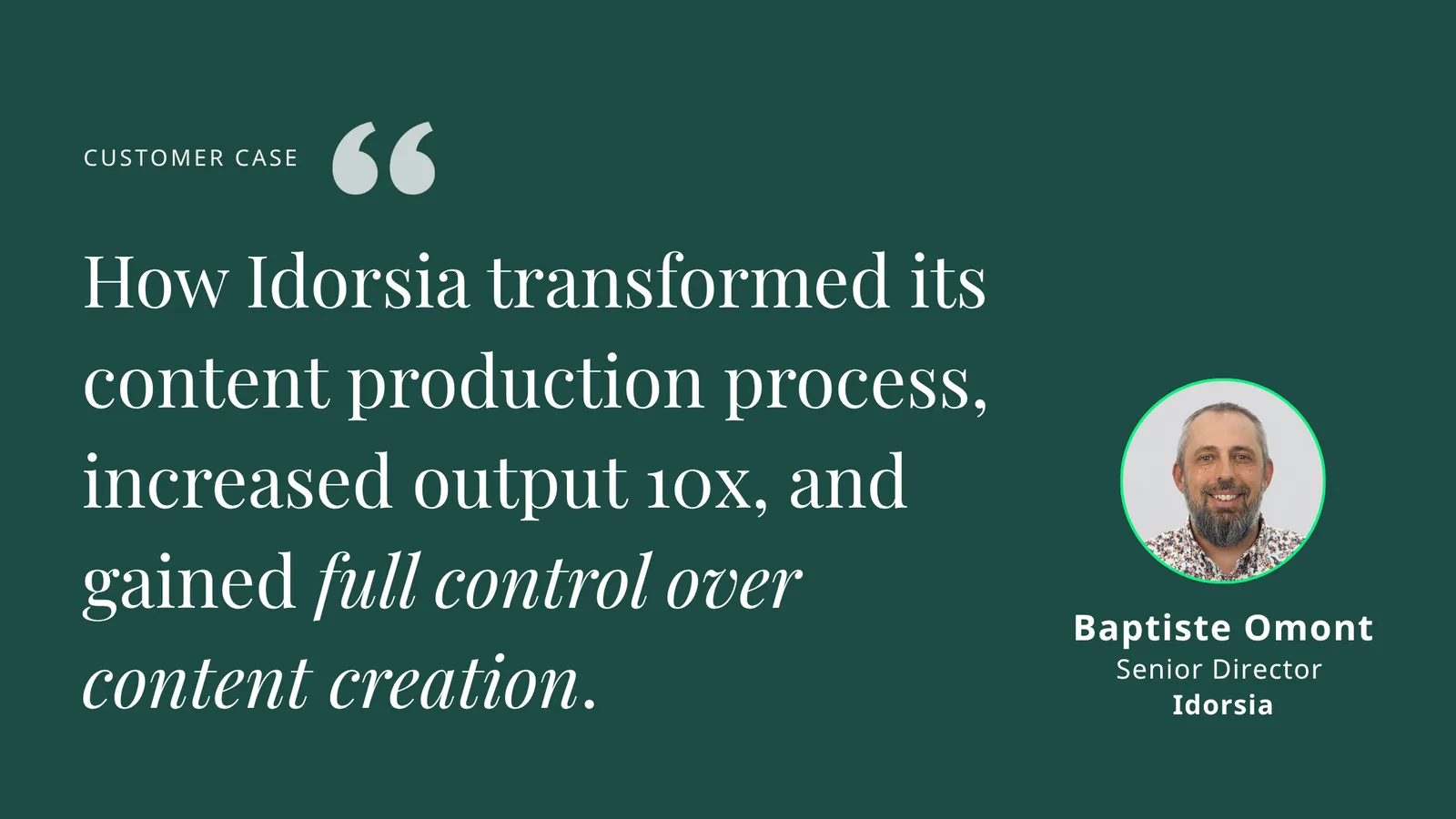
What used to take weeks now takes days. We’ve cut our dependency on external teams, increased output, and taken full control of content production.
That’s not an isolated result — read the full Idorsia case study. Across the teams using this approach, we typically see high day-to-day adoption: more than 65% of content shared and reused rather than rebuilt from scratch, and more than 80% of licensed users actively creating.
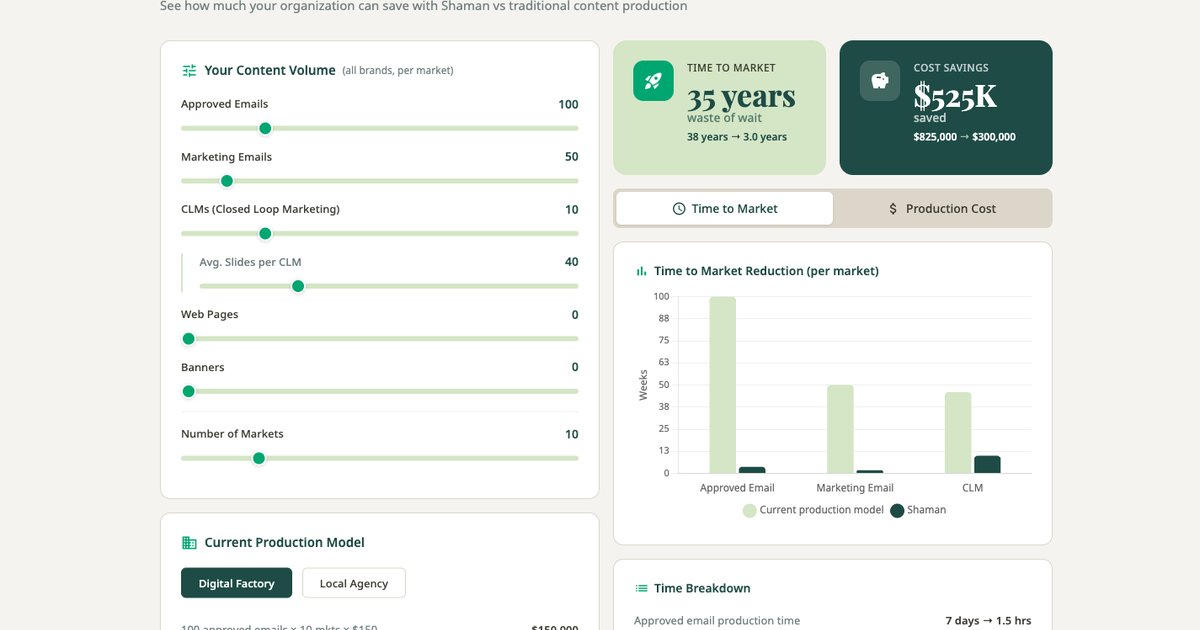
The six changes above are qualitative. What they’re worth depends entirely on your own content volumes, number of markets, and current production model.
Model your own numbers with the Content Production ROI Calculator. Set your own email, CLM, and market volumes to see the estimated time-to-market and cost difference between your current production model and a self-service approach.
Open the calculator →Frequently asked questions
How can pharma companies speed up content asset creation?
By removing the habits that repeatedly slow every asset down: handoffs between briefing and building, rebuilding instead of reusing approved modules, and catching compliance issues after submission instead of before. The six changes above cover all three.
What causes delays in pharma content production?
Rarely one single bottleneck. It’s usually a combination of handoffs (agency or central team queues), rework from late-stage MLR rejections, and rebuilding content per market instead of adapting a shared global asset.
Does speeding up pharma content production increase compliance risk?
No — the practices that speed production up (embedded compliance guardrails, upfront checks, reuse of already-approved claims and references) are the same practices that improve compliance consistency. Speed and compliance aren’t a trade-off here; they come from the same root fix.
How much can pharma teams realistically reduce content production time?
It depends on current volumes, number of markets, and production model, so there’s no single universal number. Idorsia’s own result was going from weeks to days for content production. Use the ROI Calculator to model an estimate based on your own volumes.
Still mapping the category? Our guide to pharma content authoring platforms covers what these tools do, what separates them from general design software, and how to evaluate your options.
Curious what this looks like for your team?
Book a call with our team — we’ll walk through your current production model and where these six changes would have the most impact.
If the real blocker for your team isn’t the speed of building assets but how content operations are set up in the first place — governance, ownership, ways of working — that’s a different conversation. Our Strategic Content Consultancy practice helps teams build that operating model.

Maurice has spent the past decade making content authoring solutions a reality in pharma — helping large life sciences organisations embed CAS platforms and workflows into their daily content operations, and partnering with Veeva, agencies of record and content-production consultancies to advance the field. Connect on LinkedIn.