 Maurice van Leeuwen
Key takeaways
- Flat claims libraries store pivotal-trial claims, persona rephrasings and local adaptations as equals — hundreds of entries for the ~25 claims a brand actually makes, with no way to tell which is derived from which.
- The claim is the nucleus of the module. Modules inherit their governance from their claims — get the claims architecture right and modular content works as promised.
- Generative AI removed the speed limit on variant creation. Drift that took years now takes an afternoon; variant control, not variant creation, is the new bottleneck.
- The fix is a four-layer claims hierarchy: core brand claims, medical claims, derivative expressions (indexed, not stored) and local additional claims — each with its own owner, lifecycle and governance.
- MECE rigor keeps the core small: 15–30 core claims per indication. Everything that doesn’t change the argument is a retelling, not a new claim.
In the past years I’ve seen quite a few claims libraries. Global brands, big affiliates, and small markets. If actively managed, these libraries can easily contain hundreds of claims. It’s genuinely hard to navigate. But ask the brand team how many claims they actually make about the brand, and you are likely to get a much smaller number — like 25.
That gap is a core problem of modular content today, and it only grows. In this series of three articles I make the case for rethinking the claims library from the ground up: changing the architecture from a plain, flat list to a claims hierarchy.
Not all claims are equal. That’s the thesis of this series. A pivotal-trial efficacy claim, its persona-adapted rephrase, and a local registry finding are three different objects with three different owners, lifecycles, and risk profiles. Store them as peers and you get today’s reality: bloated libraries, skeptical reviewers, unused content, and drift.
The library that ate itself
We built modular content on a promise: approve once, reuse everywhere. Break materials into claims, references, and components; assemble them into emails, eDetails, and banners; let MLR review the module instead of re-reviewing every asset.
The promise is sound. The execution, in most organizations, is not. Content production keeps climbing — up 29% in the US in a single year — while nearly 80% of approved content is rarely or never used in the field. Digital and email volume in PromoMats has doubled since 2019. Meanwhile MLR teams, unconvinced that “pre-approved” means anything once modules are combined in context, quietly re-review assembled assets in full. The efficiency case collapses.
Why? Because most claims libraries are flat: everything gets stored at the same level and there is no hierarchy. The pivotal-trial efficacy claim, the softened rephrase of it for a nurse audience, the German rework of that rephrase, the shortened banner version of the German rework. Hundreds of entries, twenty-five actual claims, and no way to tell which is derived from which.
This matters beyond the library itself, because the claim is the nucleus of the module. Modules inherit their governance from their claims — get the claims architecture right and modular content works as promised; get it wrong and no amount of module tooling will save you.
A flat library does not only grow, it degrades. Every entry looks equally authoritative. Agencies pick variants as source material. Local teams adapt adaptations. Each generation moves one step further from the approved anchor, and nobody can see the drift because the library has no concept of lineage.
An MLR reviewer at a top-10 pharma described the end state to me: the same claim living in three documents with three different references and anchors — because each agency, each new brand manager, ran their own literature search. Even facts that should have exactly one answer, like the global prevalence of a pathogen, exist in multiple competing versions, and whoever builds the next asset picks the number that suits the strategy. That is not a claims library. That is a claims landfill.
AI just removed the speed limit
Until recently, variant proliferation was throttled by human effort. Rewriting a claim for a new persona, channel, or market took an agency, a brief, and a PO. Drift took years.
Generative AI removed that constraint. AI-generated variants are now effectively free — any marketer can produce twenty on-brand rephrasings before lunch. If your library is flat, you’ve just connected a firehose to a structure that was already leaking. Drift that took years now takes an afternoon. Variant control, not variant creation, is the new bottleneck.
This is not an argument against AI in content operations — quite the opposite. It’s an argument that structure is now the binding constraint. AI amplifies whatever system it’s pointed at. Point it at a governed claims architecture and it helps compress production timelines. Point it at a flat library and it will maximize the mess.
Four claim layers, not one bucket
The fix is a claims hierarchy: layers that restrict how the library grows over time. It starts by recognizing that not all claims are equal. I propose we classify claims into four types, each with a different role, lifecycle, derivative rules, and governance:
Core brand claims
The brand’s argument · 15–30 per indication · changes only with pivotal data
The MECE set (explained below) of things the brand actually asserts: efficacy on primary and secondary endpoints, safety and tolerability, performance in patient subgroups, unmet need, QoL outcomes, MoA, and pragmatic claims like dosing and administration. These derive from the pivotal and key supporting studies. They are the top of the pyramid — everything else in your content estate should ladder up to one of them.
Crucially, this set is relatively small and static. It only changes when new pivotal data reads out, a label extension lands, or the SmPC is updated. A sizing heuristic: core claims ≈ indications × claim themes. For most brands, per indication, a disciplined MECE pass yields 15–30 core claims. If your “core” list runs past 100 per indication, you’re most likely storing variants as claims.
Medical claims
Locked to the evidence · the substantiation backbone · tightest governance
Study-derived statements taken 1:1 from the evidence: endpoint, population, comparator, effect size, significance. These are the claim-substantiation backbone — the claims your references and anchors actually support. Their semantics are locked by the source study; their governance is the tightest of all four layers. (In article 2 I discuss why these behave differently from marketing claims — and why that difference is where most MLR effort can be saved.)
Derivative expressions
Indexed, not stored · always generated from the core · anchors attached
All variants of core brand claims: the same core claim reframed for an HCP persona, told inside a patient-journey narrative, compressed into a subject line, adapted for a rep-triggered email. Semantically identical to a core claim; presentationally different.
Here is the counterintuitive rule: derivatives should be indexed, not stored as claims. Index them so approved expressions can be recognized and reused. But the moment you promote a derivative into the library as a peer of its parent, you’ve created a second source of truth — and the next derivative will be crafted from it. Variant creation is a job to be done repeatedly and cheaply (by humans and increasingly by AI), always from the core claim, always with the anchor attached. That single discipline is what prevents variant-of-a-variant-of-a-variant drift.
Local additional claims
Locally owned & substantiated · the only sanctioned way the list grows
Over time, local markets will legitimately extend the set: a local registry study, national prevalence data, positioning against a locally relevant topic, reimbursement context. These are real core claims — locally owned, locally substantiated, stored with the same rigor as the brand set. They are the only sanctioned way the local claims list grows.
The rest of this series is built on these four types. This first article makes the case for the hierarchy itself and the rigor that keeps the core small. Article 2 goes deep on the sharpest divide — why medical and marketing claims need fundamentally different rules. Article 3 shows the payoff: how a small core turns anchors, localization, and business rules from overhead into leverage.
Use the MECE storytelling rule
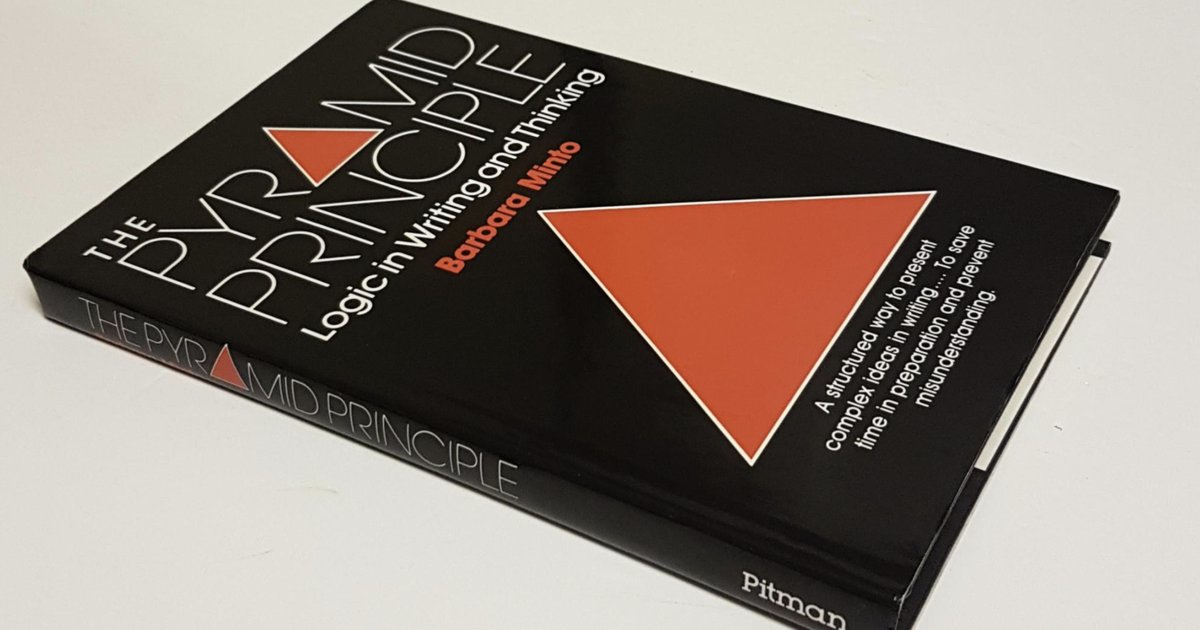
The taxonomy above borrows from Barbara Minto’s The Pyramid Principle — a book I read years ago about structuring arguments, and one I keep coming back to in content strategy (I applied it to module design in why modular content is a structure problem). It’s worth being explicit about why, because MECE is usually misread as a librarian’s rule when it is actually a storytelling rule.
In a well-built argument, every statement sits on supporting points that are Mutually Exclusive and Collectively Exhaustive: no overlap, no gaps. And each grouping’s parent statement must be a genuine summary — an insight, not a vague label. “Superior efficacy in the second-line setting” is a parent statement; “three efficacy findings” is a bucket. The test is brutal and simple: if you can’t summarize a group of claims in one sentence, the grouping is wrong.
Apply that test to a claims library and the flat-library failure becomes obvious. Twelve entries that all express the same PFS result don’t support a story — they are one claim, told twelve ways, and eleven of them belong in the derivative index. Conversely, if your core set has efficacy claims but nothing on tolerability in the elderly subgroup your brand strategy leans on, that’s a gap MECE forces you to see — before an affiliate improvises a claim to fill it.
This is why the core set stays small. A brand’s argument, per indication, resolves into a handful of parent statements (the claim themes) with study-derived support beneath each. Anything that doesn’t change the argument — different words, different persona, different channel — doesn’t make a new claim. It’s a retelling.
The value of applying MECE rigor
MECE is great. But it’s not always easy. While you go through the effort of applying it, keep the benefits of a small, mutually exclusive core brand claim set in mind:
- Reference anchor linking comes for free. Each core claim carries its reference pack and anchors once; every derivative inherits them automatically by linking to the core claim. This is key to saving reviewer time: medical reviewers spend ~5 minutes per anchor on manual fact-checking — one dense material can mean a full week of anchor verification before real review even starts. Teams that approved a messaging board first and replicated into assets have reported review-speed gains of around 80%. Recognition of an already-anchored claim — the job of an MLR knowledge engine — is the single biggest lever in MLR.
- Consistency becomes structural. When every asset traces to one of 25 claims, message consistency across markets stops depending on brand-book compliance and starts being a property of the system. It reduces the risk of drift.
- Business rules stay governable. Rules like must-travel-with and fair balance scale with the square of your claim count. Thirty core claims means roughly 450 pairs to reason about. Four hundred flat modules means 80,000. Rules attached at the core level are inherited by every derivative; rules attached at the variant level are unmaintainable.
- AI generation gets grounded. Generation and validation both need a source of truth. A governed core set gives AI something to generate from, and something to check against.
In the next article: why medical claims and marketing claims need fundamentally different rules — and why that split, more than any technology, determines how much of your MLR workload is actually automatable.
Sources: content-volume and field-utilization figures from the Veeva Pulse Field Trends Report and Veeva Pulse content data; anchor-verification times and review-speed gains as reported by MLR review teams; Barbara Minto, The Pyramid Principle. Companion pieces: the claims library and modular content as a structure problem.
Frequently asked questions
What is a claims hierarchy in pharma?
A claims architecture with four layers instead of one flat list: core brand claims (the small MECE set the brand actually asserts), medical claims (study-derived statements locked to their evidence), derivative expressions (persona, channel and market retellings — indexed, not stored as claims), and local additional claims (locally substantiated extensions). Each layer has its own owner, lifecycle and governance.
Why do flat claims libraries fail?
Because every entry looks equally authoritative and nothing records lineage. Agencies pick variants as source material, local teams adapt adaptations, and each generation drifts further from the approved anchor. The library bloats to hundreds of entries for a few dozen real claims, reviewers stop trusting it, and MLR quietly re-reviews assembled assets in full.
How many core claims should a pharma brand have?
A sizing heuristic: core claims ≈ indications × claim themes. For most brands a disciplined MECE pass yields 15–30 core claims per indication. If the core list runs past 100 per indication, variants are being stored as claims.
Should AI-generated claim variants be stored in the claims library?
No. Derivative expressions should be indexed so approved wording can be recognized and reused, but never promoted into the library as peers of their parent claim. Variants are generated repeatedly and cheaply from the core claim, always with its reference anchors attached — that discipline is what prevents variant-of-a-variant drift, especially now that AI makes variants effectively free.